Longevity & the Microbiome
Everywhere on Earth, Women Outlive Men. Except in One Corner of Sardinia. Scientists Looked at What's in Their Gut.
In a cluster of Sardinian mountain villages, the longevity gap between the sexes all but vanishes: men reach 100 at nearly the same rate as women, and in one village, they even edge ahead, something researchers have documented almost nowhere else. New research suggests part of the answer is hiding in their gut bacteria, including a microbe now at the center of the Ozempic story.
Key takeaways
- At age 100, women outnumber men by as much as six to one across the developed world. In Sardinia's Blue Zone, the ratio is just 1.35 to 1.
- In the village of Villagrande Strisaili, men actually edge ahead, the one place on record where this reversal has been documented.
- Sardinian centenarians carry roughly 4.7× more Akkermansia muciniphila, a longevity-linked gut microbe, than younger adults from the same region.
Almost everywhere on Earth, the arithmetic of old age is lopsided. Women outlive men, and the gap only widens with age. The higher you climb, the more the ranks of the very old are filled by women. By the time you reach 100, the imbalance is stark: among centenarians, women outnumber men by about three to one in the United States, rising to roughly six to one in Japan, with most developed countries somewhere in between. The skew holds across nearly every country with reliable records.
Except in one place.
In a band of mountain villages in central-eastern Sardinia, that gap almost disappears. Among the area's centenarians, there are roughly 1.35 women for every man, and in the village of Villagrande Strisaili, the count is so even that men actually edge slightly ahead. Men there reach 100 at nearly the same rate as women, something documented almost nowhere else.
That anomaly is what first drew demographers to the island. As scientists have dug into what sets these communities apart, the search has led in many directions, including all the way down to the bacteria living in residents' intestines. To understand what that research actually shows, the gut microbiome testing company nb1 and the research experts at DataPulse Research reviewed the published evidence on Sardinian longevity, from demographic records to the latest gut studies.

Chapter 01
The Island Where Men Don't Fall Behind
The discovery dates to the late 1990s and early 2000s, when the Belgian demographer Michel Poulain and the Sardinian physician Gianni Pes, building on an earlier centenarian census led by Luca Deiana, set out to map exactly where Sardinia's long-lived people clustered. They drew concentric circles on a map around the highest-longevity municipalities, marking them in blue ink. The innermost circle became the world's first "Blue Zone," a term now used for the handful of regions worldwide with extraordinary concentrations of very old people.
The cluster sits in the mountainous Ogliastra and Barbagia areas of Nuoro province, in villages such as Villagrande Strisaili, Seulo, Talana and Arzana. Poulain and Pes ranked towns using an Extreme Longevity Index, the share of newborns who go on to reach 100. Villagrande Strisaili topped the island at about 10.8 centenarians per 1,000 newborns, meaning a baby born there had roughly a one-in-a-hundred chance of living a full century.
The truly unusual signal was not the raw number of older people, but the men. Across the developed world, exceptional old age is overwhelmingly female. In Sardinia's Blue Zone, men nearly catch up. Researchers who scrutinized birth, marriage, and death records to rule out exaggerated ages confirmed the male-longevity finding held, making it one of the most carefully validated longevity facts in the field.

Chapter 02
What Scientists Found in Their Gut
The genetics of an isolated island population, a physically demanding shepherding life and a traditional diet all play a role. But over the past decade, attention has turned to a less obvious suspect: the gut microbiome, the trillions of bacteria that live in the digestive tract and influence everything from immunity to metabolism.
In 2022, researchers at the University of Cagliari published one of the few studies to look directly inside the guts of Sardinian centenarians. They compared stool samples from 17 people aged 100 or older, 29 in their 90s, and 46 younger adults aged 40 to 60.
One group of bacteria stood out as the signature of extreme age. The phylum Verrucomicrobia, and in particular, a species called Akkermansia muciniphila, was markedly enriched in the centenarians. In the study's data, the Akkermansia genus was several times more abundant in the 100-year-olds than in the younger controls. The people in their 90s had their own marker, a bump in Bifidobacterium, while the youngest group leaned more heavily on Bacteroides.
In other words, the oldest residents did not simply have "more bacteria." They had a distinctive microbial fingerprint.
This pattern, however, is not unique to Sardinia, and the study's authors stress this themselves. An enrichment of Akkermansia has already been described in earlier research on centenarians in other regions. What this Sardinian study contributes is therefore not the discovery of a special regional microbiome, but the confirmation of a recurring longevity marker, here among Sardinia's centenarians.
One thing the data cannot settle, though: whether these bacteria help people reach 100, or simply reflect a lifetime of healthy eating. The studies show correlation, not causation: a pattern, not proof of cause and effect.
Chapter 03
The Ozempic Connection
Akkermansia muciniphila has had a remarkable few years. Once an obscure resident of the gut's mucus lining, it is now one of the most talked-about microbes in metabolic medicine, because researchers have linked it to GLP-1, the same hormone that drugs like Ozempic and Wegovy are designed to mimic.
Laboratory studies have shown that Akkermansia and the proteins it produces can stimulate cells to release more GLP-1, the hormone that signals fullness and helps regulate blood sugar. That research is still mostly at the cell and mouse stage, not a human longevity trial, so the science here is about a plausible mechanism rather than a proven cure. But it has been enough to turn Akkermansia into a commercial product: biotech companies now sell live-Akkermansia capsules, some marketed explicitly around their potential to support the body's own GLP-1.
The neat coincidence is that the same microbe enriched in people who naturally live to 100 in a Sardinian mountain village is the one biotech is now bottling for its metabolic effects. Whatever Sardinia's centenarians are doing, they appear to have been cultivating it the slow way, through a lifetime of eating, long before anyone could buy it in a jar.
Chapter 04
What They Actually Eat
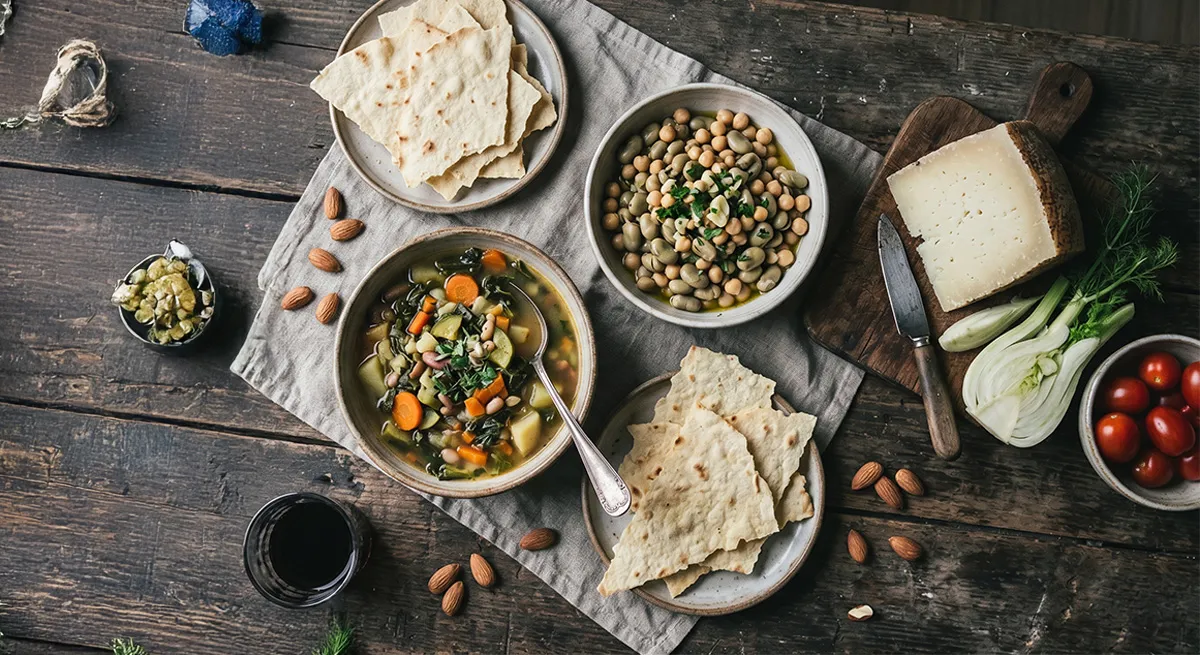
The traditional Sardinian shepherd's diet is not exotic, and it is not complicated. It is plant-heavy and fiber-rich: sourdough and barley breads, including the thin flatbread pane carasau; beans and legumes eaten almost daily, such as fava beans and chickpeas; minestrone thick with garden vegetables; pecorino cheese from grass-fed sheep; fennel, tomatoes, and almonds; and a modest daily glass of the local Cannonau red wine. Meat is occasional, not central.
What ties this back to the gut is fiber. The bacteria enriched in the Sardinian centenarians are those that thrive on plant fiber and the mucus layer of the intestine, producing the short-chain fatty acids associated with a healthy gut barrier. The same Cagliari study found that the centenarians' microbial profile tracked with adherence to a Mediterranean-style diet. No single food has been shown to "grow" Akkermansia on demand, but the broad pattern is consistent: a fiber-forward, largely plant-based way of eating feeds exactly the kind of bacteria these long-lived people carry.
That is the most actionable takeaway, and the most honest one. You cannot move to Sardinia or borrow its genes. You can eat more of what its centenarians eat.
Chapter 05
A Necessary Caveat
Blue Zones have drawn skepticism. A 2024 analysis argued that some longevity hotspots may reflect record-keeping errors or pension fraud rather than genuine clusters of very old people, and the debate is ongoing. It is worth saying plainly. But Sardinia is the best-defended case: its male-longevity data was independently validated against multiple historical records, and a coalition of demographers publicly pushed back on the broad-brush critique in 2024. The microbiome study, for its part, is small and observational, so its findings describe bacteria associated with extreme age, not a proven cause of it.
None of that erases the core anomaly. In one corner of one island, men live almost as long as women, they carry an unusual set of gut bacteria, and they eat in a way that happens to feed those bacteria. Each thread is documented. Together, they make Sardinia one of the most intriguing natural experiments in human longevity.
Chapter 06
What It Means for the Rest of Us
For most of the world, the longevity gap between the sexes is a fact of life, and centenarian wards are overwhelmingly female. Sardinia is the reminder that the gap is not a law of nature. Genetics set part of the stage, but daily habits, including how we eat and what we cultivate in our gut, write much of the script.
The science itself is also moving. Most of the studies above use 16S rRNA sequencing, an older method restricted to identifying bacteria, mostly at the genus level. Repeating this longevity research using newer shotgun-metagenomics sequencing would unlock much deeper insights. Because shotgun technology reads all genetic material simultaneously, it expands the view beyond bacteria to capture viruses, fungi, and archaea. Furthermore, it resolves these microbes down to the specific strain and reveals the metabolic genes they carry. This transforms our understanding from a simple roll call of bacteria to a functional map of what the entire microbiome is actually doing to promote health.
The science of the microbiome is young, and no stool sample will hand you a guaranteed century. But understanding what is actually living in your gut, and how it compares to the patterns seen in the world's longest-living people, is no longer the stuff of remote research labs. It is something anyone curious about their own health can now begin to measure.
Frequently Asked Questions
Why do men live as long as women in Sardinia's Blue Zone?
No single factor explains it. Researchers point to the genetics of an isolated island population, a physically demanding shepherding life, and a traditional plant-heavy diet, and more recently to an unusual gut-microbiome profile. The male-longevity finding has been independently validated against birth, marriage, and death records, but the full causal picture is still being studied.
What is Akkermansia muciniphila?
It is a species of gut bacterium that lives in the mucus lining of the intestine. In the 2022 University of Cagliari study, it was markedly enriched in Sardinian centenarians compared with younger adults. It has become one of the most discussed microbes in metabolic medicine because researchers link it to GLP-1, the same hormone that drugs like Ozempic and Wegovy mimic.
Is the Ozempic link proven?
No. Laboratory studies show that Akkermansia and the proteins it produces can stimulate cells to release more GLP-1, but that research is still mostly at the cell and mouse stage, not a human longevity trial. The science describes a plausible mechanism, not a proven cure, and no probiotic is a substitute for medication.
Can diet change your gut bacteria?
The broad pattern is consistent: a fiber-forward, largely plant-based way of eating feeds the kind of bacteria these long-lived people carry, and the 2022 study found that the centenarians' microbial profile tracked with Mediterranean-diet adherence. That said, no single food has been shown to "grow" Akkermansia on demand, and the findings describe bacteria associated with extreme age, not a guaranteed route to it.
Methodology
The cross-country comparison of centenarian sex ratios uses a single source, the UN World Population Prospects 2024, so the figures are directly comparable; Sardinia's "Blue Zone" ratio is a sub-national figure from the AKEA study, shown to illustrate the anomaly rather than as a like-for-like national comparison.
Findings on the gut microbiome are associations reported in published studies, not proven causes of longevity, and the link between Akkermansia muciniphila and GLP-1 is based on cell and animal research. All sources are linked throughout.